Blackkklansman (d. Spike Lee)
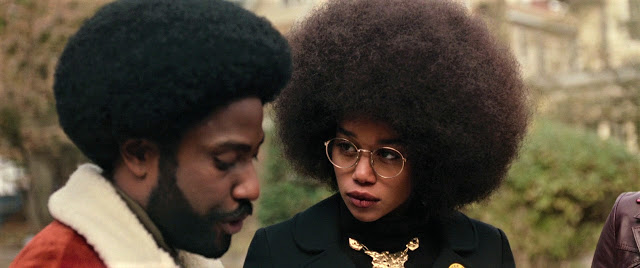
Interesting to see two films with black protagonists using the “white voice” released in the past year. For Lee, speaking with a white voice also means a black director making a Hollywood film about racism for the widest/whitest possible audience. The black protagonist, an undercover cop, calls it being a professional. Now I don’t know which aspects of the book has been fictionalized and sensationalized, but I felt an uneasy at the artistic decision to crosscut between the klan meeting and black activists’ gathering. It has this weird effect of equating both events, even though it’s presented as how these two groups are very different. It’s so weird to see a full-on klan initiation in a film about racism where something like this in another movie could be problematic. On the other hand, we get to hear a gut wrenching account of lynching and how it was such violence was normalized back then that children attended these racist spectacles. Lee also shows us images from actual lynchings, something that probably has been a Hollywood taboo. I kept wondering if this crosscutting could have been done differently, or is this an aesthetic echo to Griffith’s innovative use of cross cutting in that fucking odious film Birth of a Nation that the film shows short snippets of. We also get to see an obviously tacked on segment of a racist and sexist police officer getting his due. The segment works as a way of reconciling one’s uneasiness with the way the film shows how the police can be a force of good for black people. Huh!?! Is this what it takes to get a film about race, racism, and rising white nationalism, produced in Hollywood? Is this what it means to be a professional in the system? Then Lee gives us a powerful ending from recent events of protests involving American Nazis and counter-protestors, splicing it with together with fury and finesse. It’s that film I wanted to see. It seems like that’s the film he wanted to make. It’s that film that we need.
#2019 #14
 Orpheus in Hell: Unlicensed Film Reviews