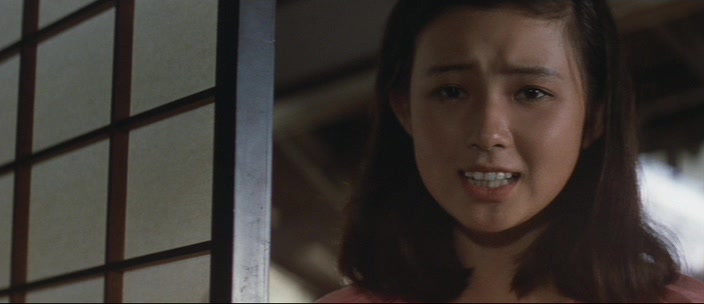
Went to the Matsumoto Toshio screenings. Saw two feature lengths and four shorts. Funeral Parade (1969) is by far his best work. Shura (1971), while good, is just good. His period films are not quite convincing. War at the Age of Sixteen (1974) suffers from indecisiveness. Is it a commercial film or an art flick? He injects sentimental music of the period here and there and a titty shot of a character who’s supposedly sixteen. Otherwise, film is about memory. At 16, heroine’s mother faced the war. Her daughter, meanwhile, at the same age, faces ennui. She’s too opaque to be taken seriously despite her suicide attempts. Even the stranger, when it comes down to it, doesn’t have much in terms of characterization. He’s there to stir up trouble in the family. This isn’t an original idea, Toshio, the whole thing sounds like Pasolini’s Teorema (1968). The actress playing the mother has a passing resemblance to her Italian counterpart. Each character is burdened by a personal memory which is a reflection of an aspect of national history. The mad uncle, if I’m understanding the film correctly, listens to the speech of the Emperor’s surrender over and over again to make him return to a calmer state. The climax occurs during a rural festival where, finally, all the secrets are unraveled. The film seems like an acute and accurate portrayal of how Japan negotiated the disconnection between war-time traumas and postwar affluence. (The film would make an interesting double/triple bill with Teorema or even Pigsty (1969) or Resnais’ Muriel(1963)) What’s crucially missing in the discussion of Japan’s responsibility in the deaths, violence, and trauma to other nations during the wars and colonial period. Matsumoto and co. cannot seem to conceive that others may have suffered and that the country’s prosperity is in some ways a result of the colonial projects of the past. This is why the film ends rather happily but not satisfactorily for the more critical viewer. The reunion isn’t with the young people, as is usually the case, but the between the industrialist husband and the bourgeois wife.
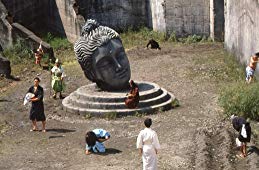
Dogura Magura (1989) is about madness. It’s about the indeterminacy of truth and reality as the protagonist, and, by extension, the country is headed toward disaster. The film is set in the 20s but is also about late 80s Japan. A strange murder case is at the center of the movie which involves a mentally unstable young man and his mother. Egging him on are two psychiatrists where one or both of them might not be who they are. The film seems to criticize psychiatry and institutions in general in their inability to assess the public it serves and steer the nation to a saner course. Matsumoto orchestrates the chaos between one plane of reality/madness with skill and panache. Yet I kept wondering what if this hall of mirrors game is actually a sign of entrapment that this is what Japaneseness is, a constant referring to itself, an endless loop, with no escape, which is why the final shot is that of incarceration. Part of the inability of escape or alternative has to do with the historical inability to reckon Japan’s own war crimes. Matsumoto cannot or dare not consider this in the equation of his obvious left wing stances. This is why when he makes his semi autobiographical and tongue-in-cheek short called Dissimulation (1991) where he plays himself, a director at 60, he can no longer engages in national themes but his personal career. It’s actually funny and tries to have the complex structure of Dogura Magura but fails instead. It’s still a worthwhile work since he revisits the areas where he shot War at the age of sixteen but without any sense of politics or revolt. His late 60s short called Mothers (1967) is more intriguing as he tries to connect the lives of four different mothers under the guise of a children’s film. Incidentally, his work seems to be preoccupied with mothers and absent fathers, two very important figures in post war Japanese society not in the psychological sense but as the economic producers of the family unit and citizen/ consumer/tax payers. The short features an eyebrow raising document of an African American mother in what is probably Harlem. He doesn’t make her speak but shows her with a glass of alcohol and dancing to some music. Matsumoto would then shift his focus to Vietnamese mothers , a clear swipe at the America’s military engagement in Vietnam. Images of war and violence, but where are similar images of what Japan did? It’s not part of the Matsumoto parade.
#2018 #March
 Orpheus in Hell: Unlicensed Film Reviews