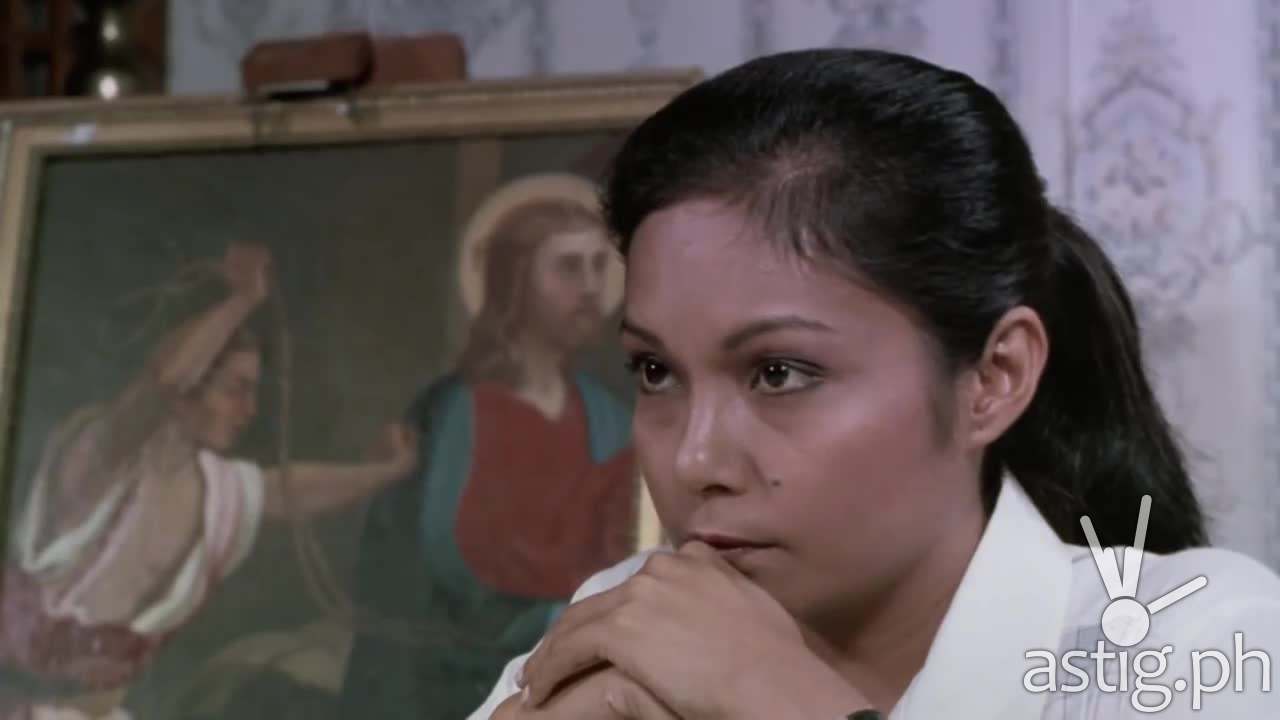
T-Bird at Ako (1982) (d. Danny Zialcita)
Caught a bizarre, enjoyable Tagalog film on TV starring Nora Aunor and Vilma Santos, two of the country’s top leading ladies and box office rivals, with overt lesbian overtones. Both women usually represent the Nation: Aunor is darker-skinned while Santos is much fairer and has the much-prized Hispanic features. So it was interesting to see how these two would hook-up which never happens except for the split-screen ending where Aunor’s lesbian tendencies are suddenly “cured” and she ends up paired with a man. Both can co-exist as part of a heterosexual coupling but cannot be together, perhaps reflective of the state of the nation–not just in terms of prejudice against homosexuality but also the divided state of country, which was still under Marcos rule. Film was released in 1982. One of the most hilarious sequences (serious but definitely played for laughs for its witty banter) is in the courtroom where all the platitudes about morality and justice are expressed. It’s a bitter laughter because of the hypocrisy of these concepts under the repressive regime. There’s even a close-up of a judge when he says that he will make sure that the “truth will be uncovered”, which in the national realm, with the extrajudicial killing of activists and journalists of the time, would render such a thing as “truth” as a fantasy. A review of the film found in the internet claims that the plot is in fact “flimsy”, and why not since the point of the courtroom case is not the crime in the story but the audience have gathered for a mock trial of the Marcos dictatorship. The happy ending of the two coupling at the end reveals that there can’t be any reconciliation and desires, signified as lesbian in the work, have to be repressed. Tellingly, Aunor’s character’s reformation occurs at a mall: her happiness and integrity has been/can be bought.
The mis-en-scene may offer clues to the ideological negotiations going on in the work–and by “work”, I also take into account the national project of defining itself. For instance, one of the funny lines in the courtroom scene is when Santos tells the prosecutor that she understands what he’s saying since he’s using English that’s not very deep. (“Hindi malalim”.) It’s a dig at the intelligence of the witness and also a marker of class differentiation. (Also worth mentioning is that both Aunor and Santos are playing against type here. Such a line would be more suitable for a character that Aunor would usually play.) In a pivotal scene where Aunor reveals her feelings for Santos, a huge portrait can be observed in the background. Eventually, the camera gets close enough to show a partial view of the photograph. It’s none other than a presidential portrait featuring both Ferdinand and Imelda Marcos at an official ceremony. This is something that people used to hang in their homes, perhaps out of national pride but also out of fear so that their political allegiances cannot be questioned. There are other scenes when framed paintings or prints has the curious effect of echoing or underlying the themes of the scenes at hand. I think this is accidental. It would seem that the nation itself has become a movie set where its citizens, in the absence of fully functioning laws, end up playing roles and knowing which roles to play properly. The alternative would be to end up disappearing from the national scene completely.
#2015 #May
 Orpheus in Hell: Unlicensed Film Reviews