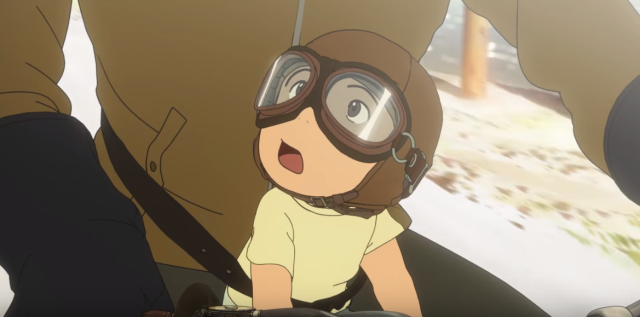
Mirai (Mirai no Mirai) (d. Hosoda Mamoru)
The Japanese title is Mirai no Mirai, which is a play on words because Mirai is the young boy’s little sister’s name and mirai also means future. The kid either imagines or falls into a fantasy world where he skips along different periods in Japanese history. The important timeline is when the young boy meets her younger sister as a teenager while he remains a young boy. Got that? The film is trying to show that the young boy, petulant and jealous over the new addition to the family, needs to learn to be more responsible and nicer to his parents and sister. The movie travels back in time to show how his grandparents met and how his mother, despite her constant nagging over his behavior, was no worse than him at his age. It also moves forward in an alienating, and this is key, murkily multicultural Japan as seen in the Tokyo Station sequence. The cute and playful way he falls into this other world is entertaining, but when examined deeply, shows a rather linear and rigid sense of time. Two main things concretize this linear and literal time. First, there is the careful renderings of homes in the film. The current day home is, despite what grandmother says, modern, unique, and playful. The very visible Hadid volume is no accident. The homes of the past are smaller and more traditional, especially in the use of wooden and paper materials. There is an implied story of an economic trajectory here. The grandparents lived humbly, while kid’s parents improved upon that, and the current house is no usual middle class adobe. In fact, I’d say it’s slightly upper middle class or shows a financial security/confidence in spite of the employment circumstances of the parents. The dad is now a freelancer which means mom has the stabler and probably higher pay check. In these small ways, the film wants to show a modern Japan, but not too wildly modern, just enough to cover up its actual conservatism. Because of the linear time structure of the film, there is an implied sense that the next generation, Mirai’s and his brother, will live a better life too. I think this is part of the appeal of the movie in post-Fukushima and post-bubble Japan, that somehow the future is bright as long as we take some responsibility now, where responsibility is not civic or environmental but personal and national. How is it national? This is where the second item where time is concretized, which is in the form of the traditional Japanese dolls. In the film, the dolls need to be put back immediately after Girl’s Day or else, superstitiously, Mirai’s bridal prospects will suffer. There is a whole sequence about putting the items back properly and completely played off as a comedic bit but is in fact gravely serious in terms of traditional continuity and preservation. As long as rituals are practiced accordingly, disaster can be forestalled.
One additional thing, the film sensitively portrays the grandfather character based upon a past incident, which we later learn actually occurred during the war. It’s interesting how WW2 comes into play here, which turns this film from personal fantasy to personal-national. The scene is brief but also significant because it grounds the story into history. There is no further contextualizing the war here except as a Japanese historical event…which brings me to my Okinawan background. How are Japanese people from Okinawa supposed to relate to this? I immediately felt I was dispensed from this story. This is why I find the movie slightly off-putting. Like many mainstream Japanese texts, it can not deal with Okinawan, and by that I mean what happens during the war when Okinawans were demarcated as not Japanese enough for their discrimination and slaughter. In this way, this is not my Japan and I’m not supposed to be part of it. Fine by me though, but I want to show that despite its cuddliness, the film is not easy to embrace, especially by someone who is imagined as not properly Japanese subject.
#2019 #50
 Orpheus in Hell: Unlicensed Film Reviews