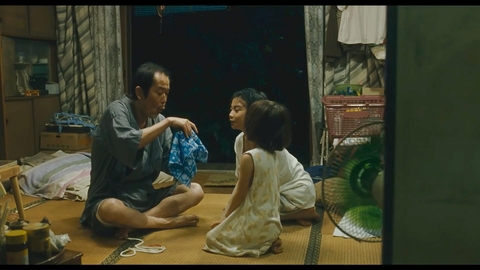
Shoplifters (d. Kore-eda Hirokazu)
I really wish that the movie was more biting or critical instead of its nuanced, “humane” stance. It doesn’t move beyond the realm of a standard understanding of human motivation, a kind of universalized humanism that I’m beginning to tire of. Within these parameters, the movie is a marvel. It is best exemplified by a sequence in which the weather hastily changes without actually showing the change in weather conditions but by use of light tonalities and sound effects. Human motivation, the movie seems to be saying, is as changeable and unpredictable as the weather and that there is usually more than one motivation in our consciousness. This seems to be a condition among family members where, in what seems like a soft critique of Japanese culture, the family here is based on survival and affection for the discarded instead of relation by blood, a still important feature in Japanese life. Absent from all this is a clearer picture of what renders these people outside of mainstream society. At the very least, Kore-eda highlights the irregular work conditions of some of the family members. Yet, in contradistinction from usual movies where money seems to flow, it’s also difficult to gauge why these folks are desperately poor if they’re also grifting and shoplifting, like, all the time. Surely they could afford paying for a particular ritual but instead they do things privately–as in they basically do the digging themselves. Or are they just really that cheap? Even though important revelations are revealed elliptically, the movie invests in an emotional economy. For instance, I didn’t find the film particularly funny in the first section and particularly tearjerker-y in the second half as some initial Cannes coverage had characterized the film. The sentimental scenes are understated which may account for my muted reaction. I think the movie deliberately doesn’t have a corresponding portrait of a material economy that prevents me from fully convinced of the film. Is there a connection between the economic state of these characters with their emotional ones when the films seems to insist that their core being is somewhat removed from their “poor” conditions? It’s this chasm that I wish was bridged or bridgeable, but then maybe I’m asking too much. Sometimes hearing the celebrations at a distance counts as celebrating itself or so the movie says at some point.
Changed my mind. The film shows how Japan is digging its own grave by the manner it treats its undesirables. However, the definition of such peoples is quite narrow. No handicapped people, no ethnic minorities, etc. The deviancy seems economically based. In addition, the state, in the form of the police, although rigid in their outlook and line of questioning, still holds a recuperative function by elevating the figures above their former socioeconomic status at the expense of emotional connection. With these things in mind, Kore-eda and co. have made a decent movie, but also, in the time of crushing world wide political, economic, and environmental upheaval, do any of these things matter? An auteurist film with old fashioned ideas about humanism? I need something more radical and life-sustaining, truth be told.
#2018 #June
 Orpheus in Hell: Unlicensed Film Reviews