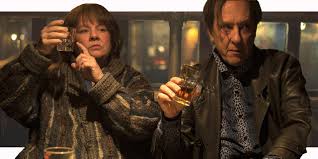
Can You Ever Forgive Me? (d. Marielle Heller)
I didn’t articulate well why I didn’t like this rather well-made movie. On the literal level, it’s a film about an unlikable character who forges documents in order to pay the bills. She, a lesbian, befriends a gay man who has seen better days and who also may be into small time grifting. Their friendship is another key aspect of the film as both navigate 90s NYC, an era they don’t seem to belong to. On another signifying level, the movie is about white privilege—which the film celebrates since with its anti-heroine figure. Why is it about white privilege? Well because a) she wouldn’t have been able to enter into these establishments where she sells the forgeries and tricks the buyers into purchasing her items had she been a non-white person and b) her accompanying stories of where she got these items, from relatives who are into certain authors, would not have seem believable had it come from a racial minority. With the absence of POC in what is supposed to be NYC, what the film does is to create a closed off world of white people only interacting with people like them—which is more than likely as seen in the writer parties shown in the film. The only time we see POCs are at the start of the film, with no speaking parts, and they are shown to differentiate themselves from her, the loser character, but also the heroine, whom we are supposed to identify with—that to cheat creatively may not be all that wrong if the original is improved upon (that is the film’s message)—or at least to sympathize with her. The other character is a middle-aged gay guy who keeps putting up appearances despite hints of him being homeless and isolated. His “white privilege” comes in the form of a young Latin lover; despite his age and circumstances, he is able to hook up with a sexy young dude. The heroine, even in her repugnance and deception, manages to have someone attracted to her. Thus in the film, even though these characters are without money, they still have access to things and people that POC do not; and these things are just slightly in the background of the film and hasn’t been noted in the reviews I’ve read. Lastly, there is no mention of the increasing gentrification of the time period being depicted. She continuously cannot pay the rent but this is ascribed to her unemployment. The gay guy is homeless because the bohemia of his youth, including cheap dwellings, are things of the past. None of this is hinted at because the film is interested in her “crimes”. Can you imagine a WOC entering and accessing a university library archive and stealing documents from there? We are supposed to cheer her on but had it been another kind of person, they would have been restricted from entry or gone to jail—with a tougher sentence. Instead she ends up writing a book about it and gets it adapted into a film. That’s what I mean by white privilege. So yeah it’s nice to cheer on a movie that has lesbian central character and friendship with a gay person, but it’s their whiteness, their access to things, that I can’t relate to at all.
#2019 #24
 Orpheus in Hell: Unlicensed Film Reviews