Once Upon A Time in…Hollywood (d. Quentin Tarantino)
(Revised)
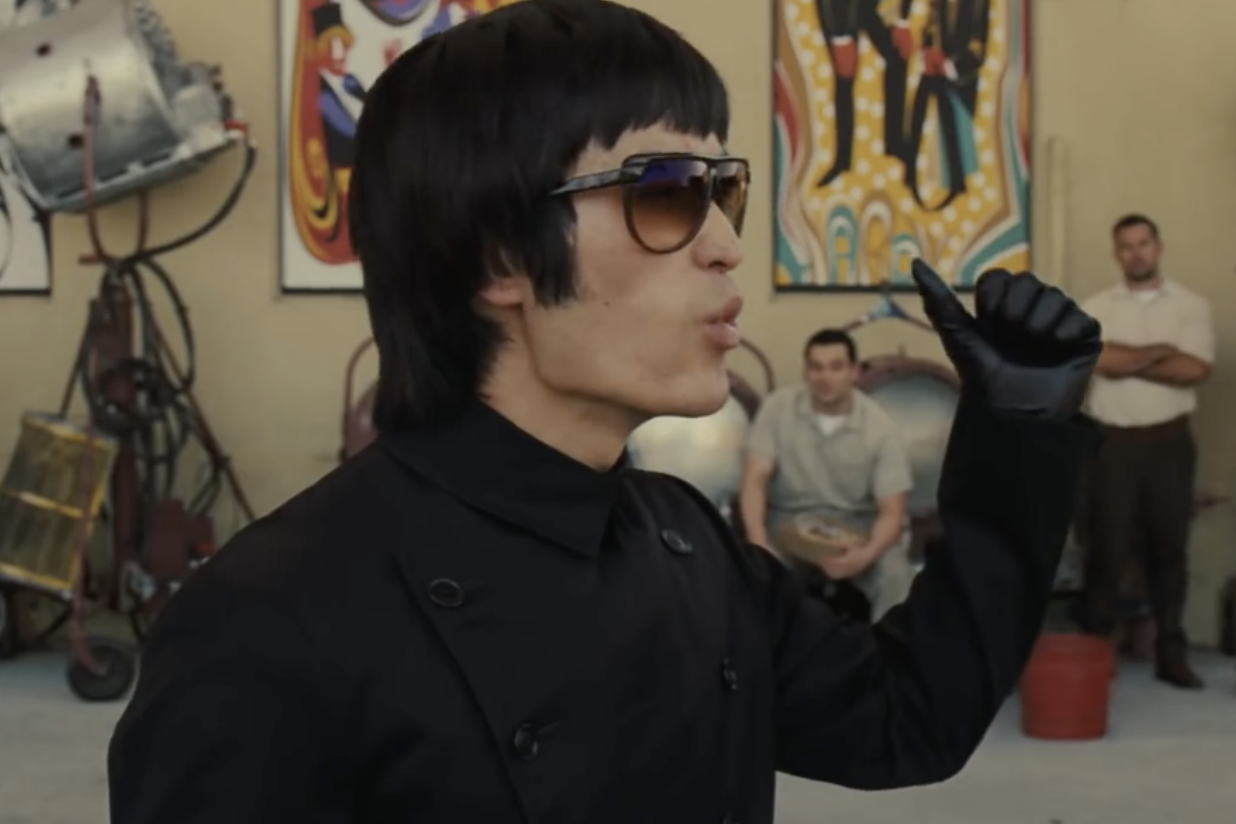
My entry into the film is through the undignified portrayal of Bruce Lee. He is shown as a trash talking fake. Why? So that Quentin can build up the Brad Pitt’s character’s badass-ness. Who is he, Cliff Booth? He is a stunt double for an increasingly washed up actor, Rick Dalton who is played by Leonardo DiCaprio, which makes him a copy of the original version. Booth lives in a trailer. His income highly dependent on the viability of his boss as a TV star. In short, Booth is the archetypal figure of the economically diminished straight while male figure that have been appearing in Hollywood films lately.
In 2018 alone, thoughtful films about such figure have appeared in such movies as Leave No Trace, You Were Never Here, First Reformed, and The Rider. In contrast, Tarantino’s version is far more assertive. Despite Booth’s age and his lowly status in the Hollywood hierarchy, he can still kick the butt out of a martial arts legend, no less. What does the sequence, which is played for laughs, signify? It means that no matter how economically disadvantaged the white man has become, and this is where the film taps into the current mood of the country, he is still better than the Asian guy.
As a consummate cinephile, Tarantino must be aware just how important it is for Asian-Americans (and Asian-Canadians) to have this sole figure to idolize at the dearth of viable representations of Asians and male Asians in mainstream culture. Instead, Tarantino has Booth refer to Lee as Kato, the second banana in the Green Hornet TV series. Meanwhile, Booth is mistaken for the assassin John Wilkes Booth. Moreover, with the notable absence of any mention of the ongoing war of the film’s period, isn’t Lee also a stand-in for the Vietnamese? In this fantasy tale, the Americans get to beat the Asians.
Tarantino isn’t done yet. If he can treat an iconic Asian figure in this manner, how do other figures fare? Let me be direct: how does he treat his female characters? As the climactic sequence shows, he literally bashes them over and over again. It is a degrading death for one such character as she is torched to death. Astonishingly, Tarantino spares Sharon Tate and her baby. In a sense, Tarantino is offering an alternate fantastic version of Hollywood history—which also explains the fairy tale-like evocation of the title. It is the white heterosexual family that triumphs and survives over the two other non-traditional familial formations: the murderous, polyamorous Manson Family and Booth’s and Dalton’s bromance. The baby’s survival signals the continuing reproduction of the white nuclear family and the production of movies.
Meanwhile, Tate is a strangely vacant presence as portrayed in the film. She simply reacts to things: laughing and pantomiming from a movie she starred in, the Southern California summer heat; and some pop music of the era. Tarantino shoots her to capture her beauty but not her essence, because there is none. She is the material ghost of the real thing, a second banana, an alternate being. What kind of woman then pass muster in Tarantino’s eyes? A precocious prepubescent girl. As long as a female character does not have the threatening mark of sexuality, she can be smart and engaging and, most significantly, not subject to a violent death.
The movie is also a bromance between Booth and Dalton. “He is more than a brother and little less than a wife,” says Dalton referring to his pal Booth. (Sounds like a gay-for-pay porno tagline, if you ask me.) They go out drinking together, and Booth leaves his toothbrush-equivalent, an acid-laced cigarette, at Dalton’s house. Booth even follows Dalton to Europe and is finally ditched for a bona fide heterosexual female partner. Booth has been a wife stunt double, too. Economically, he is basically Dalton’s housewife since his income is tied up to his boss’ status as a celebrity. The film is set at the very tip of the late 60s and early 70s where the studio system is at a complete downfall and the big bucks are now tied to TV. For washed up stars like Dalton, cheap European and international co-productions are a means to earn much needed cash. Tarantino is more interested in the aesthetics than the economics of the period. This is precisely why he is able to intricately and delightfully recreate vintage TV shows, B-movies, and even comic books.
There is no mention of Booth’s membership in any stuntman’s union, instead the film keeps emphasizing his masculine virility. The bloody finale represents this virility at the expense of his actual economic situation. He has no place to go back to after the break up but to his rusty old trailer. The film seems to make an appeal to present day audiences in time of the gig economy: you can be violently virile too despite your precarity—even at the cost of the dignity of others.
#2019 #119
 Orpheus in Hell: Unlicensed Film Reviews