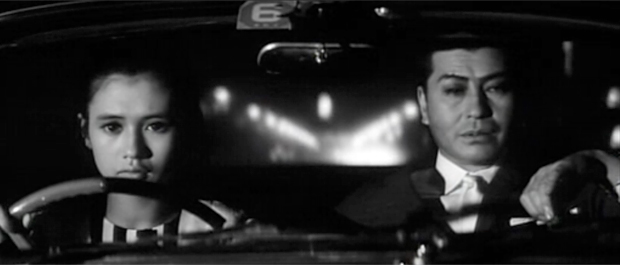
A Flame at the Pier / Namida wo shishi no tategami ni (d. Shinoda Masahiro) (1961)
Pale Flower (d. Shinoda Masahiro) (1963)
Two films about instrumentalizing oneself for the service of others. Flame at the Pier (1961) has the embers of the war still burning ever just so slightly as the protagonist’s loyalty is based upon him being saved as a child during the war. Pale Flower (1963) is set in a cash-rich Japan even though the protagonist, despite his wads of money and killer clothes, lives in what looks to be an abandoned warehouse. Flame is a rather dumb movie. Dumb protagonist. Dumb female lover. Dumber decisions. It’s a studio flick and Shinoda can only do so much. Are we to sing along to that sentimental song with the protagonist after he murders someone? After he and the audience realize that the guy he has killed is his lover’s father? No, we are not that stupid nor heartless.
The film is about loyalty or the system in place where people follow a code of loyalty however debilitating, criminal, and amoral. This is why the protagonist abets in a murder. The actual killer is the other guy who accompanies the protagonist to the mugging. A cut to the other guy’s hand with the rock is there to displace complete condemnation from the audience, so, technically, it’s not the hero who kills. He just has terrible tastes in music and friends.
Meanwhile, the actual criminals are the capitalist bosses, but they are strangely protected from the violence. Shinoda shows a similar thing in the latter film. The violence affects workers and “middle management”: the vicious bosses and the lower-rung mobsters. For the director, the elites are too busy hobnobbing with Americans or fellow mobsters. They are more concerned with eating etiquette (the “use your spoon properly” remark in Pale Flower) and entertaining white foreigners on their yacht a la L’Aventurra (the movie poster shows up later in the cafe, watch for it) while wearing rompers (seriously).
Economic and physical violence are the realm of everyone else. The nagging question I have with the earlier film is why was it fine to continue idolizing someone who directs one to commit murder? Isn’t that the absolute limit? The film doesn’t sensationalize this point and it yet has another reel to tell, which means that murder is narratively and ethically acceptable as long as it was done out of duty and loyalty. Crazy. Moving on, who exactly is the flower of the title if the female character disappears (like in the Antonioni film) in the final reel? That makes the male protagonist the flower in the movie: he who can not survive and wilts in the post-war milieu of yakuzas and capitalists.
The yakuza bosses are shown as obsolete grandpas living in modernist European-style houses with European affectations. The sequence at the dentist is memorable for its very disjunction: the actor playing the mob boss has bad teeth and yet here he is at the dentist getting his teeth cleaned. It doesn’t make sense and I think that is Shinoda’s sly way of underscoring the ineffectuality of the new system while others, like the protagonist, still follow an older loyalty system to his detriment. For what? For the code? For his psyche? We get an extended dream sequence beforehand to indicate the inner tension that he feels but cannot resolve in his waking life. Meanwhile, the murder scene is set in a high class European restaurant set to an operatic aria: Japan, despite its civilizational trappings and better economic outlook, was still bound by outdated forms of thinking is what Shinoda seems to be saying. One such traditional ideal is to be used by higher powers for their gain and profit.
Before I close, one last observation. Where is the political consciousness of the workers? In the uneven Flame , the dock workers organize–to little avail. Their union bosses end up dead and they cannot rely on the police nor the justice system to get justice for their murders. Meanwhile, there is absolutely no such political consciousness in the later film. It’s all about the death drive, literally, as the man and woman speed their way dangerously into the long lonely night. Meaning to say, the earlier film might be slightly “better” ideologically because of its more obvious political commitments.
#2019 #117 #118
 Orpheus in Hell: Unlicensed Film Reviews