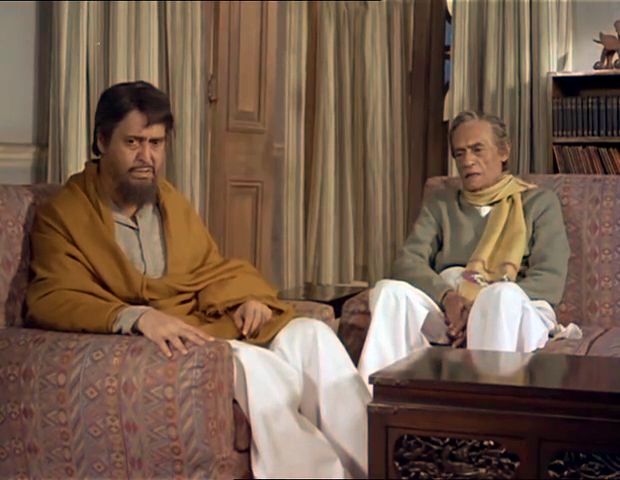
Branches of the Tree (d. Satyajit Ray) (1990)
From 2014.
Made and released in 1990, Ray’s film arrives as an artifact of a bygone sensibility, with its deliberately slow pacing, as it explores each branch of a family tree, and a belief in simpler virtues (“Work is faith” and “Honesty is the best policy”). The set-up is straightforward: a father who’s turning 70 and his four sons and their families. One of the sons suffers from a brain injury caused by a motorcycle accident when he was in London as a student. He serves as the holy fool in the film. His incoherent babbling also represents the trauma of a particular class of Indians who were indoctrinated by British values through education but who now find themselves unable to identify with post-independence India. It’s such an odd, antiquated notion that I was surprised to even find it as a subject in a late work by a long-time filmmaker.
Could it be that Ray’s films are also about the mourning of the loss of the direct contact with the colonizer’s culture? Note that the final scene isn’t a familial reunion as much as a nostalgic embrace of the British past. The patriarch’s life reflects the nation’s development after Independence, while the sons’ careers reflect their own era, which is characterized as full of corruption. The conversations of black money and its white counterpart seems naïve at the moment of globalization, but Ray has no other vocabulary to conceptualize his worldview. Interestingly, it was black market money that reinvigorated Indian Cinema after the collapse of the studios after the war. Is Ray saying that making a black money film is inevitable at the time of the film’s production? Is this why there’s an unexpected dubbed song sequence in the film?
The gaunt patriarch in his sick bed is later echoed by Ray holding his honorary Oscar in his hospital cot during the Academy Awards telecast. What then to make of the patriarch’s own father who still lives in the same house? He is senile and an unwanted presence. To follow the logic of the film, he signifies India before Independence and Partition. But can’t he also be India without Britain? Isn’t this why he can’t speak coherently? I found this character troubling, as he scuttles back to his back room unable to cross over an invisible spatial threshold. Ray’s preoccupation with culture, class, and ethics, has always struck me as an appeal to the civilized West, leaving those not with the program gawking at the camera with no words and music to express their stupefaction.
#2014 #July
 Orpheus in Hell: Unlicensed Film Reviews