“If there’s a book that you want to read, but it hasn’t been written yet, then you must write it.”
–Toni Morrison
I mourn the loss of my previous blog. It was a record of a time and place different from what came before and the present. I also mourn the loss of my old life for its imagined promises and, yes even, the despairs it held. However, here we are, years later, in another place, quite literally, as I live in another country and occupy a slightly different frame of mind. The doubts are the same–and so is the passion for cinema. (For a few years there, I had to distance myself from it, mostly because no good movies were available and the internet was slow in my exile in the Philippines. The sun was ablaze in the tropical country but my soul remained gray.) There’s huge difference with regards to how I think and write about movies these days. Race, which was previously ignored or diminished, has come to the forefront. Not just in racial representation but how race is articulated even in its apparent absence on the screen. The shock came in the form of realizing how my racialized sexuality and identity in my North American life shaped my fate, especially the psychic one. The blog is about finally finding the vocabulary that was not available in my personal life (for years and decades) that I can now use in the form of film reviewing. It also explores how race, class, sexuality, among many others, animate Western cultural texts. The reviews were always written off-the-cuff and posted on social media. For the blog, they have undergone some editing to clarify ideas and correct grammar errors though at times I have left them there to maintain the raw quality of my (mis)judgements. More ambitiously, I am hoping that these notes and writings are a form of cultural criticism by someone who imagines themselves as an queer, exiled outsider. The tone is decidedly combative and impassioned; and, like most internet ephemera, I expect the blog and it contents will likely disappear and be forgotten as the terms of engagement for social justice values broaden and move on. Finally, the aim is not to preach nor accuse but to identify knotty social issues like race to see ourselves arrive at an impossible future of equality, sustainability, and solidarity beyond the multiplex.
Leftist white savior narrative that does not understand the problem of white savior tales
Transit (d. Christian Petzold)
Some thoughts on Transit. It offers an alternative universe where fascists are closing in on dissidents and minorities in what looks to be contemporary France. The mood harks back to WWII movies, including its unchecked orientalism. Why does Petzold set it in sun-drenched Marseilles which looks more Mediterranean than Europe? Because it evokes the idea of borders, and we have to keep this in mind that it is a deliberate artistic choice. Why not set the border in the metropole itself? In Western Europe? What bothers me about this film is that non-white figures are still rendered in the same fashion as other movies: in need of help and pity—instead of characters that are full of motivation and initiative. The Arab woman is doubly silenced as she is made mute. The white male protagonist would like to act as a savior to woman and her child—the same kind of chivalry that we saw in Petzold’s Jerichow (2008). Even then, the non-European immigrant fails in so many levels on European soil. Is it inconceivable for Petzold to see or represent immigrants who are actually thriving? Why the resistance? The movie is about how present day fascism is a continuation/remixing/reviving of past versions and the same archetypal idiotic heroism of quixotic heroes, which also means, according to the movie, the incapacities and beta-ness of non-white people. Dear Christian, to fight back, we need all people on board, like literally, but you want some of us to be left behind.
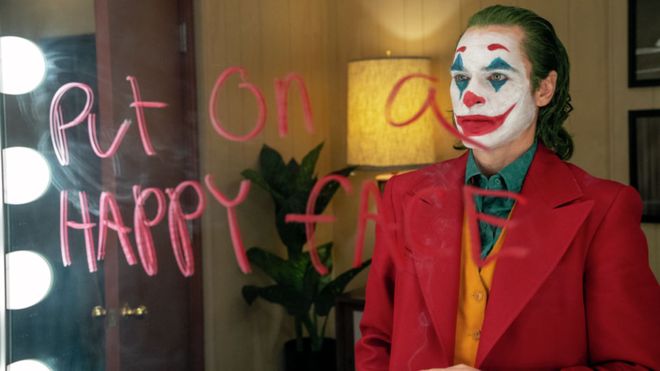
Only Joaquin Phoenix could have played this role in a movie that exhibits a kind of sensibility very much of the present rooted in doublings. Joaquin has his dead brother’s career, River, for those who can still remember the deceased’s short-lived stardom. The film itself is the twin other of Phillip’s Deadpool movies: too much and non-stop yucks—because laughter can also be estranging, thus the cacklings of the Joker and the belabored plot point of why he laughs the way he does. The film wants to cater to prevailing sentiments: populist and anti-establishment and sympathy for the civilizational burdens of the white straight male.
Let’s begin with the cityscape. Why an adaptation of Taxi Driver-era NYC, complete with De Niro doing a version of King of Comedy? Our major cities no longer look like this; in fact, the white flight that turned cities into crumbling dystopias has reversed course and cities are now gentrified AF, segregated racially and by class. Well, because the movie wants its hero to be a byproduct of a crime-ridden city that is (insert drum roll here) visibly non-white. Note the opening: It’s a gang of brown teenagers that mug him, followed by the appearance of two strong black women who are pointedly shown as misunderstanding him. The joke here is that these women appear to be in a socially more advantageous position than he is—the straight white dude. This is also where we first encounter his laughter where it functions as lack of intimacy or his inability to find community with these figures. It’s the same laughter one hears when demeaning jokes are made targeting minorities passing off as hipster, un-PC, or South Park-style humor. This plot choice of setting the birth of rage in a distant and imaginary past (because it’s not real but more like a cinematic rendering of the past) seems like a cop-out to me. It’s easier and creatively lazier to make social ills as the cause of resentment. How can a Joker figure emerge from an urban space full of gleaming high rise condos, vegan bistros, and overpriced coffee shops?
The film is as incel-y as expected, especially the misogynistic reasons for Joker’s madness. (Why does the film insists on multiple causes?) Mother dear has not been such a dear, after all; (the casting of Frances Conroy, playing another iteration of the psycho mom in Six Feet Under, is already a sign); he also discovers his virility after murdering three white Wall Street bros by fucking his exoticized black neighbor right after, or so it would seem. Sexuality, violence, and humor (for him but insult and tragedy for the rest of us) all jostle together in his notebook, which is what the movie essentially is, a manifesto/notebook/pageant for the incel-inclined. So how does race come in, aside from the strategic racialized opening mentioned above? “You don’t mean shit to them,” the black caseworker says regarding the budget cuts that would stop his medications, “and I don’t mean shit to them” (paraphrased). This might be the case, even in our shared world of austerity, but the whole point of the movie is that they (white male anti-hero and those who self-identify with the plight of that subject) will not let this happen passively. They will fight back, like the protestors in the movie and out in the streets, even if that means killing people who are in the same boat, the black caseworker, the stand-in for minorities who are and may seem slightly above them socially and economically. The bloody footprints tell us so. (Fuck inter-class solidarity, their whiteness and manliness is more important than anything else.)
The economic factor is also time-warped. The class resentment is against the old American oligarchy represented by Thomas Wayne. (Yup, Bruce’s pop.) He could easily be a Carnegie or a Ford or a Rockefeller—instead of the Bezoses or Musks of the world. The economic system, because the film is set somewhere in the late 70s and early 80s, does not match with current realities, which has the effect of vacating more realistic economic and political reasons for the diminishment of the American white middle class. It’s the wrong bogeyman as is usually the case with Hollywood product. The reason we get a Thomas Wayne is to make yet another laborious reason for Joker’s existence: he could possibly be (MAJOR SPOILER) Bruce’s half-brother. Since it is a movie about doublings, their brotherhood occurs twice in the film. There’s a shot of the birth of Batman cut to Joker’s laughter as if he knows even though it is diegetically impossible. It is meant to be creepy and prophetic, but this is where the major gap in the movie is: how can the white nationalist incel types know for sure the veracity of their racist, sexist, and politically regressive beliefs? They don’t, that’s why they resort to crude laughter and violence. They are the negation of intimacy: they, like the Joker, dance alone.
Who is this movie for? We have two screen-like windows in the film. For the less prosperous family, it’s a small submerged opening while for their wealthier counterpart, it’s large and magnificent—and the view ain’t that bad either. The reason I ask this question is because, while the movie seems to be about class resentment, the characterization of the rich folks tend to be facile, and, as the climax shows, perhaps not worth the fury in placing a knife through their Chanel sunglass-ed illusions. In other words, the rich are way too nice and naive for the film to be an effective grilling of them; well, because it’s more likely that the film will be seen and appreciated by this demographic. The poor, as the film shows, have no appreciation of art unless it is googled.
If the director is aiming for some type of statement about class, the one he comes up with is quite devastating: instead of class solidarity, in-fighting within the lower classes are the cause of much violence and pain. In fact, the representation of the third family in the film, the one that does not begets any children, is shown as both mentally deficient (misplaced loyalties) and mentally ill. They are not of this earth, literally; they are not of the formal nor gig/grift economy either but merely surviving.
Meanwhile, the financial situation of the grifting family is equally quizzical. With their combined income, as the patriarch says, they could move out of their cramped, semi-underground quarters, but they don’t. There isn’t any improvement except for the occasional dining out. Where is the money going and what do they plan with it? This economic factor becomes blurry because the film has a) other allegories in mind and b) it is not really interested in a Marxist or quasi-Marxist commentary. It just wants to show that there is an economic divide and if you rich folks (self-identifying or wannabees) are naive enough, you guys will be taken in.
The other important specter is North Korea. As a character points out, a key edifice was built as a place to hide from bombs and creditors. The movie seems to conflate the two in its second half, which is why the economic aspect becomes less prominent, less biting. The doubling repetition of a character and his fate does not make sense, narratively and visually, if the underlying de/re-unification of the Koreas is ignored. The final sequence stages a wishful reunion not just with the flesh and blood characters but of these two nations.
In a lecture given in 1996, the late novelist Toni Morrison postulates, “Infinity is now, apparently, the domain of the past…Twenty or forty years into the twenty-first century appears to be all there is of the “real time” available to our imagination…(In) the late twentieth century (unlike in the earlier ones) it seems to have no future that can accommodate the species that organizes, employs, and mediates on it. The course of time seems to be narrowing to a vanishing point beyond which humanity neither exists nor wants to. It is singular, this diminished, already withered desire for a future.”
The seminar seeks an open-ended discussion from interminable or ongoing projects that concern the working throughs of the present and future in the absence of a legible futurity. Accepting the impasse as a productive opening, the seminar welcomes previously impossible ideas, associations, and solidarities that concern potentials and limits of cultural and scholarly productions that deal with or affected by the multiple catastrophes of the era, from climate crisis; adjunctism and the gig economy, and surging xenophobia and fascism. Of interest is the vexing issue of temporality: In the absence of future, what can we do in the time being? On one hand, a voluntary withdrawal from the current state may engender formulations and discovery of discourses from unexpected elsewheres. On the other, embedding oneself in the struggles of the moment (time-being-ness) may result in discovering solutions or building upon existing concepts and communities.
The seminar welcomes papers that show how literature, film, and activism are engaged with thinking about a future that is, as all indications show, impossible. Also invited are papers that look into how artists and writers dissented or negotiated their ideals through repressive political and economic regimes that, at that time, seemed inevitable. Papers that deal with texts that are and were pregnant with ideas and messages for belated readings are encouraged too. Welcome are papers that also deal with their own impasses or blockages.
Topics might include the following but are not limited to them:
Non-linear temporalities
Incommensurability of texts
Photography and filmed images of repression and protests
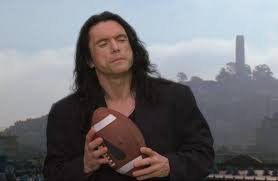
I finally went to see the midnight movie The Room last night and read the film seriously despite the hoots and talk back from the audience. It is a bad film in a sense that director/writer/actor/producer takes cliches sincerely from bad objects like soft-core porn movies, meaning to say a) he seems to have learned his cinematic language from marginal sources and b) that part of the movie’s appeal is the audience feeling superior to the director’s obliviousness to mainstream cultural markers.
There was a bro-ness to the atmosphere of the crowd that is fed by the film’s misogyny. The lead female character is a mess of character motivation: she’s sexy, blonde, and disloyal. It’s only the director who seems out of place with his stoic Nosferatu-like expression and unconvincing line delivery. In fact, I would argue, The Room is an immigrant’s cri de coeur. The underlying fear is that of alienation from a society that is not one’s own which explains the director’s lack of self-awareness of the various elements in the film such as how bad his acting is. The obvious use of green screen with its foggy and gauzy view of San Fran shows that the film is about his fantasies: an improvised American family, a group of friends, and a go-go-go career. And yet, all of these things fail him. The film attributes his failure to the woman who cheats on him with his BBF. How lazy and sexist is the representation. (Check out the same kind of woman that appear in current bromances.) The best friend is shown to be a young, blonde-haired babe and he is meant to be the archetypical American boy next door. Their dalliance represents the immigrant guy’s a) insecurities by being with a blonde American woman and b) fears that folks close to him will choose their own kind or what is familiar over his dark hair and cryptic European accent.
While the audience laughed at the seemingly inept and incongruous cross-cutting with scenes of the city, especially towards the end, I found myself sympathizing with the director’s sense of un-locatability. He tries to master the cityscape with his own gaze but the gaze is not returned by anyone. The final shot indicates that he blames society for his failures and that the same society can only accept him if he just disappears. The movie is not unreal, there’s some thought to this movie unlike a lot of H-wood films, but it’s that America, even for a white immigrant, can be an unreal place.
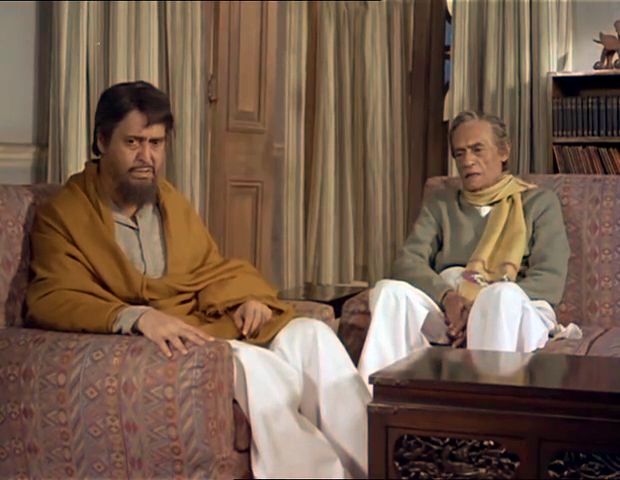
Made and released in 1990, Ray’s film arrives as an artifact of a bygone sensibility, with its deliberately slow pacing, as it explores each branch of a family tree, and a belief in simpler virtues (“Work is faith” and “Honesty is the best policy”). The set-up is straightforward: a father who’s turning 70 and his four sons and their families. One of the sons suffers from a brain injury caused by a motorcycle accident when he was in London as a student. He serves as the holy fool in the film. His incoherent babbling also represents the trauma of a particular class of Indians who were indoctrinated by British values through education but who now find themselves unable to identify with post-independence India. It’s such an odd, antiquated notion that I was surprised to even find it as a subject in a late work by a long-time filmmaker.
Could it be that Ray’s films are also about the mourning of the loss of the direct contact with the colonizer’s culture? Note that the final scene isn’t a familial reunion as much as a nostalgic embrace of the British past. The patriarch’s life reflects the nation’s development after Independence, while the sons’ careers reflect their own era, which is characterized as full of corruption. The conversations of black money and its white counterpart seems naïve at the moment of globalization, but Ray has no other vocabulary to conceptualize his worldview. Interestingly, it was black market money that reinvigorated Indian Cinema after the collapse of the studios after the war. Is Ray saying that making a black money film is inevitable at the time of the film’s production? Is this why there’s an unexpected dubbed song sequence in the film?
The gaunt patriarch in his sick bed is later echoed by Ray holding his honorary Oscar in his hospital cot during the Academy Awards telecast. What then to make of the patriarch’s own father who still lives in the same house? He is senile and an unwanted presence. To follow the logic of the film, he signifies India before Independence and Partition. But can’t he also be India without Britain? Isn’t this why he can’t speak coherently? I found this character troubling, as he scuttles back to his back room unable to cross over an invisible spatial threshold. Ray’s preoccupation with culture, class, and ethics, has always struck me as an appeal to the civilized West, leaving those not with the program gawking at the camera with no words and music to express their stupefaction.
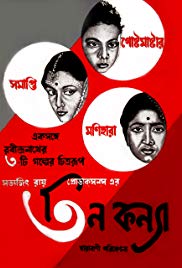
Originally conceived as a three-part film, with each story running roughly an hour long, Ray explores the fates of women in Indian society of the 50s. The middle film, the part that had been missing for decades, involves a ghost story in a once opulent mansion conceived in the manner of an English country estate. The film itself is a phantom as the film was released internationally without this section. The haunting presence or absence (since it is the thing that is not explicitly dealt with) is the issue of British imperialism and colonization. The wife’s obsession is non-sensical since the camera is concerned with the space, furniture, and ornaments of the English-style estate. (The characters in the film are ‘ornaments’ themselves as ornaments /jewelry is the key word here.) The ghost that lurks the mansion and garden outside is the influence of British values and ideas in a colonized country. What Ray brilliantly shows (by accident, I feel) is how the colonized subjects, the educated middle and upper classes, become curious actors in their own land, confused and unable to make the right decisions with regards to those unlike them: those who don’t speak English and have no British sensibilities. This is why the male character in the first section is unable to do the sentimental or right thing by mainstream movie standards. And this is why the male character in the second (third in the original conception) essentially tames his wild woman with a sentimental gesture.
On the primary level, the film uses the fate of women to show the state of Indian society of the period. These women are not Mother India (an iconic film) but instead are daughters of hers, which might explain the title. In addition, the daughter designation also frees them from the responsibility of representing the Nation; and they are of age to marry and create families of their own. But no families are created in these domestic stories. The women’s tears are epic, as Ray is able to bring out amazing performances from his actors, but the stories themselves seem to be in a tradition of (what I can only describe as an) old-fashioned humanism.
There is something intact about the characters, solid, recognizable as some kind of lower-case archetypes. They way they react to the world is in accordance to a strictly defined psychology which doesn’t waver except for the woman in the ghost story whose motivation is unstable and hence her unresolvable absence/presence which then indicates what constitutes a viable character, the one who can be read as a recognizable figure. What is of interest is the woman in the second film, the section that never got released, because her character cannot be contained and could not be sustained as a viable presence. Her state shows Ray grappling with how to portray a character of differing motivations or it shows Ray’s awareness of his own limitations because the world around him could not provide him with the vocabulary to do so.
The form of the short story itself appears to be part of this idea of humanism, in the belief that things can be conveyed in this form which Ray transmutes into the medium of film. These stories are ultimately unreconcilable, which explains the state of the film for so long with the missing middle section, because it follows the stories rigorously from its original form which in turn brings its attendant ideas about characterization and what makes one a human being. This may explain the presence of strange humans and animals in the narratives: a crazy old man, a pet squirrel, and a mysterious cousin. These are figures that never made it to becoming characters–rather they appear as ornaments in the films.
More significantly, there are the British accessories–a book by Scott or Tennyson, portraits of the royal family, western jacket, to name a few that function as signs of civilization–as the film itself tries to be. I’ve never been convinced of Ray’s work entirely (except for the poetic Pather Panchali), not sure to whose eyes these films were made for. The dismembered fate of the film reveals how colonialism has yet to be reconciled in Ray’s consciousness; and the current reincarnation of the film–the third film was screened separately–shows that the non-diegetic world of the film has yet to confront its colonial past.
A Flame at the Pier / Namida wo shishi no tategami ni (d. Shinoda Masahiro) (1961)
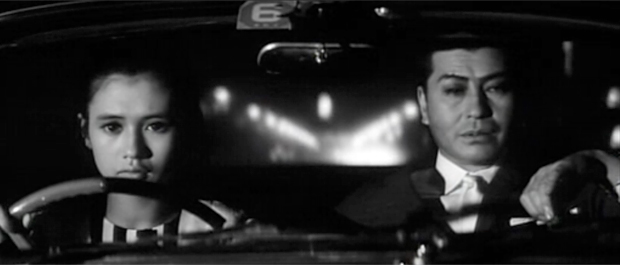
Pale Flower (d. Shinoda Masahiro) (1963)
Two films about instrumentalizing oneself for the service of others. Flame at the Pier (1961) has the embers of the war still burning ever just so slightly as the protagonist’s loyalty is based upon him being saved as a child during the war. Pale Flower (1963) is set in a cash-rich Japan even though the protagonist, despite his wads of money and killer clothes, lives in what looks to be an abandoned warehouse. Flame is a rather dumb movie. Dumb protagonist. Dumb female lover. Dumber decisions. It’s a studio flick and Shinoda can only do so much. Are we to sing along to that sentimental song with the protagonist after he murders someone? After he and the audience realize that the guy he has killed is his lover’s father? No, we are not that stupid nor heartless.
The film is about loyalty or the system in place where people follow a code of loyalty however debilitating, criminal, and amoral. This is why the protagonist abets in a murder. The actual killer is the other guy who accompanies the protagonist to the mugging. A cut to the other guy’s hand with the rock is there to displace complete condemnation from the audience, so, technically, it’s not the hero who kills. He just has terrible tastes in music and friends.
Meanwhile, the actual criminals are the capitalist bosses, but they are strangely protected from the violence. Shinoda shows a similar thing in the latter film. The violence affects workers and “middle management”: the vicious bosses and the lower-rung mobsters. For the director, the elites are too busy hobnobbing with Americans or fellow mobsters. They are more concerned with eating etiquette (the “use your spoon properly” remark in Pale Flower) and entertaining white foreigners on their yacht a la L’Aventurra (the movie poster shows up later in the cafe, watch for it) while wearing rompers (seriously).
Economic and physical violence are the realm of everyone else. The nagging question I have with the earlier film is why was it fine to continue idolizing someone who directs one to commit murder? Isn’t that the absolute limit? The film doesn’t sensationalize this point and it yet has another reel to tell, which means that murder is narratively and ethically acceptable as long as it was done out of duty and loyalty. Crazy. Moving on, who exactly is the flower of the title if the female character disappears (like in the Antonioni film) in the final reel? That makes the male protagonist the flower in the movie: he who can not survive and wilts in the post-war milieu of yakuzas and capitalists.
The yakuza bosses are shown as obsolete grandpas living in modernist European-style houses with European affectations. The sequence at the dentist is memorable for its very disjunction: the actor playing the mob boss has bad teeth and yet here he is at the dentist getting his teeth cleaned. It doesn’t make sense and I think that is Shinoda’s sly way of underscoring the ineffectuality of the new system while others, like the protagonist, still follow an older loyalty system to his detriment. For what? For the code? For his psyche? We get an extended dream sequence beforehand to indicate the inner tension that he feels but cannot resolve in his waking life. Meanwhile, the murder scene is set in a high class European restaurant set to an operatic aria: Japan, despite its civilizational trappings and better economic outlook, was still bound by outdated forms of thinking is what Shinoda seems to be saying. One such traditional ideal is to be used by higher powers for their gain and profit.
Before I close, one last observation. Where is the political consciousness of the workers? In the uneven Flame , the dock workers organize–to little avail. Their union bosses end up dead and they cannot rely on the police nor the justice system to get justice for their murders. Meanwhile, there is absolutely no such political consciousness in the later film. It’s all about the death drive, literally, as the man and woman speed their way dangerously into the long lonely night. Meaning to say, the earlier film might be slightly “better” ideologically because of its more obvious political commitments.
Once Upon A Time in…Hollywood (d. Quentin Tarantino)
(Revised)
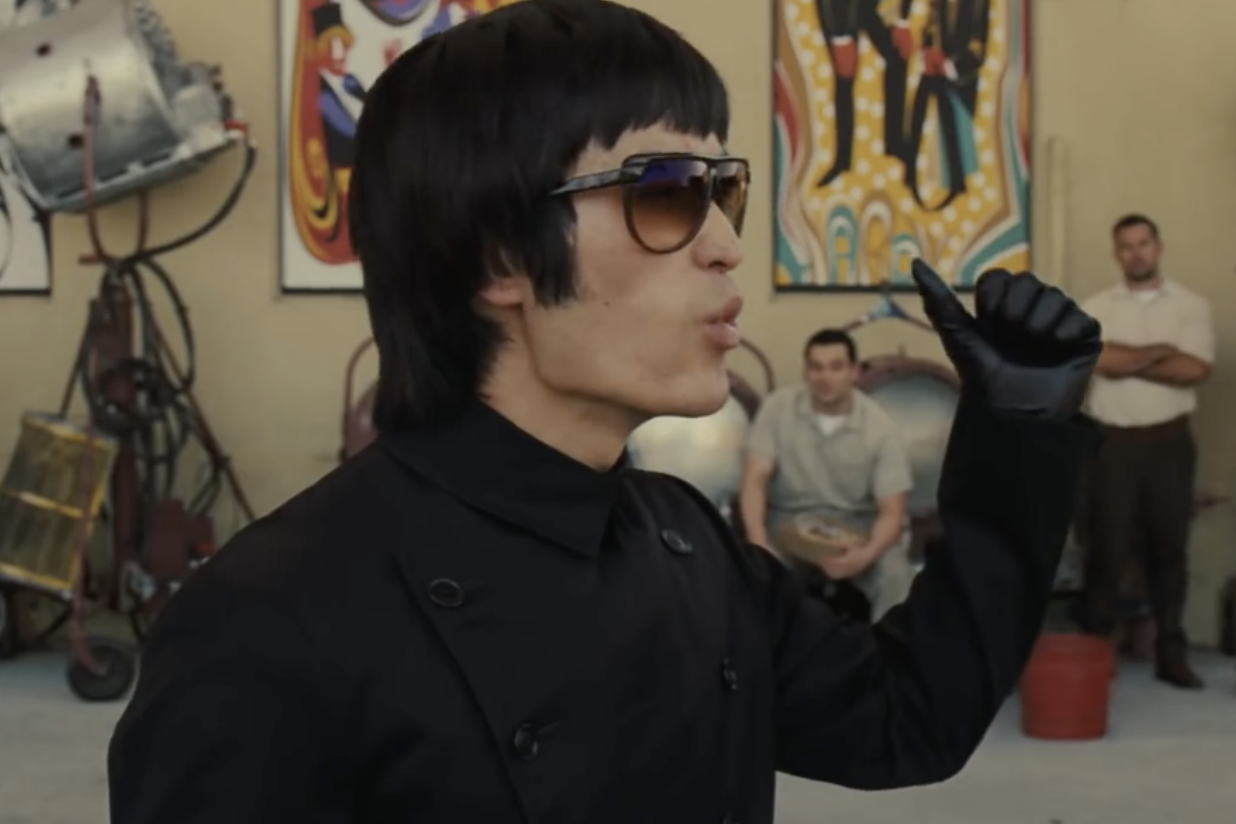
My entry into the film is through the undignified portrayal of Bruce Lee. He
is shown as a trash talking fake. Why? So that Quentin can build up the Brad
Pitt’s character’s badass-ness. Who is he, Cliff Booth? He is a stunt double
for an increasingly washed up actor, Rick Dalton who is played by Leonardo
DiCaprio, which makes him a copy of the original version. Booth lives in a
trailer. His income highly dependent on the viability of his boss as a TV star.
In short, Booth is the archetypal figure of the economically diminished
straight while male figure that have been appearing in Hollywood films lately.
In 2018 alone, thoughtful films about such figure have appeared in such
movies as Leave No Trace, You Were Never Here, First Reformed, and The Rider.
In contrast, Tarantino’s version is far more assertive. Despite Booth’s age and
his lowly status in the Hollywood hierarchy, he can still kick the butt out of
a martial arts legend, no less. What does the sequence, which is played for
laughs, signify? It means that no matter how economically disadvantaged the
white man has become, and this is where the film taps into the current mood of
the country, he is still better than the Asian guy.
As a consummate cinephile, Tarantino must be aware just how important it is
for Asian-Americans (and Asian-Canadians) to have this sole figure to idolize
at the dearth of viable representations of Asians and male Asians in mainstream
culture. Instead, Tarantino has Booth refer to Lee as Kato, the second banana
in the Green Hornet TV series. Meanwhile, Booth is mistaken for the assassin
John Wilkes Booth. Moreover, with the notable absence of any mention of the
ongoing war of the film’s period, isn’t Lee also a stand-in for the Vietnamese?
In this fantasy tale, the Americans get to beat the Asians.
Tarantino isn’t done yet. If he can treat an iconic Asian figure in this
manner, how do other figures fare? Let me be direct: how does he treat his
female characters? As the climactic sequence shows, he literally bashes them
over and over again. It is a degrading death for one such character as she is
torched to death. Astonishingly, Tarantino spares Sharon Tate and her baby. In
a sense, Tarantino is offering an alternate fantastic version of Hollywood
history—which also explains the fairy tale-like evocation of the title. It is
the white heterosexual family that triumphs and survives over the two other
non-traditional familial formations: the murderous, polyamorous Manson Family and
Booth’s and Dalton’s bromance. The baby’s survival signals the continuing
reproduction of the white nuclear family and the production of movies.
Meanwhile, Tate is a strangely vacant presence as portrayed in the film. She simply reacts to things: laughing and pantomiming from a movie she starred in, the Southern California summer heat; and some pop music of the era. Tarantino shoots her to capture her beauty but not her essence, because there is none. She is the material ghost of the real thing, a second banana, an alternate being. What kind of woman then pass muster in Tarantino’s eyes? A precocious prepubescent girl. As long as a female character does not have the threatening mark of sexuality, she can be smart and engaging and, most significantly, not subject to a violent death.
The movie is also a bromance between Booth and Dalton. “He is more than a brother and little less than a wife,” says Dalton referring to his pal Booth. (Sounds like a gay-for-pay porno tagline, if you ask me.) They go out drinking together, and Booth leaves his toothbrush-equivalent, an acid-laced cigarette, at Dalton’s house. Booth even follows Dalton to Europe and is finally ditched for a bona fide heterosexual female partner. Booth has been a wife stunt double, too. Economically, he is basically Dalton’s housewife since his income is tied up to his boss’ status as a celebrity. The film is set at the very tip of the late 60s and early 70s where the studio system is at a complete downfall and the big bucks are now tied to TV. For washed up stars like Dalton, cheap European and international co-productions are a means to earn much needed cash. Tarantino is more interested in the aesthetics than the economics of the period. This is precisely why he is able to intricately and delightfully recreate vintage TV shows, B-movies, and even comic books.
There is no mention of Booth’s membership in any stuntman’s union, instead the film keeps emphasizing his masculine virility. The bloody finale represents this virility at the expense of his actual economic situation. He has no place to go back to after the break up but to his rusty old trailer. The film seems to make an appeal to present day audiences in time of the gig economy: you can be violently virile too despite your precarity—even at the cost of the dignity of others.
Female Student Guerrilla (d. Wakamatsu Koji) (1969)
Dare to Stop Us (d. Shiraishi Kazuya) (2018)
Did Japanese Cinema lose a promising filmmaker in 1971?
Dare to Stop Us follows the brief period of collaboration known as the Wakamatsu Pro (productions) between Wakamatsu and Adachi. The focus is, surprisingly, on a novice female production assistant who quickly wins over the respect of Wakamatsu-san, portrayed as a hippie asshole, and rises through the ranks where she is given a film project of her own after two years on the job. It’s a short film that was supposed to be incorporated or repackaged with another film to be offered to a commercial studio. Wakamatsu, ever insensitive to his protege’s feelings, dismisses the end result as the other team members muster some words of admiration to spare the feelings of the lone female film director in their midsts.
The most interesting aesthetic decision that Dare to Stop Us makes is to forgo a strict period piece look. Right from the very start, it shows Megumi, the novice, and her recruiter walk through a very visibly contemporary Tokyo despite the subtitles indicating that the action is supposed to be set in 1969. This choice has the unnerving effect of showing continuity between the past and present conditions of being a woman in Japan, one who is artistically inclined and independent-minded enough to do what she wants to do. I thought she was a fictional character until the end credits where they show actual photos of her that were recreated in the movie. So this is where I’m a bit uneasy with the film because it shows that ultimately a woman cannot do these things, artistic and have a career, because, like Megumi, she will not find the balance, courage, support, freedom, choice, etc., because such a woman will die or will have to die as Megumi commits suicide.
According to the movie, she was pregnant at the time of her death; She was also in a relationship with a co-worker and an unstable one with her biological mother. The film could have dealt with her situation in a different way, I think. It could have been more vague as to the connection between her failed love and family life and her suicide. Instead, the movie shows that women are incapable of handling their own life issues, what more a career? Additionally, what is distressing is that someone like Megumi has no viable social and mental space within and outside of her.
In short, the movie, which shows the lives of rebel filmmakers, is itself not critical enough about social and material issues when it comes to women. The rebellious tone of the title then is only limited to the men in the movie. Megumi wants to partake in a peeing contest that is a running joke in the film. She is restrained in doing so and not just because biologically. In fact, the movie says that for Japanese women to dare the impossible, they will be stopped in their tracks. Because of baby. Because of limited options. Because of the asshole-ry of patriarchy.
The Wakamatsu film is failed politics. While there are female student guerrillas in the movie, there are three horny male rebels too. The movie follows a group of high school students who sneak into their school to steal everyone’s diplomas days before their graduation and go play teenage rebels in the mountains. What Wakamatsu and Adachi (scenarist) had in mind was to express dissent at the state of society through eroticism. But eroticism for who? For the men, yes, but it’s blatant sexism for the women involved. Their offer of free love and sex is equated as a political act. That is so juvenile. A more radical stance would have considered the role and status of women in society but seeing what kind of guy Wakamatsu was in the movie reviewed above, it comes to no surprise. Instead the movie has young women gyrate to pop music topless and fuck an unwilling nationalistic nut job. This kind of exploitation is not so different from the capitalist and nationalist fucks who exploit workers and citizens that Wakamatsu wants to ridicule.




 Orpheus in Hell: Unlicensed Film Reviews