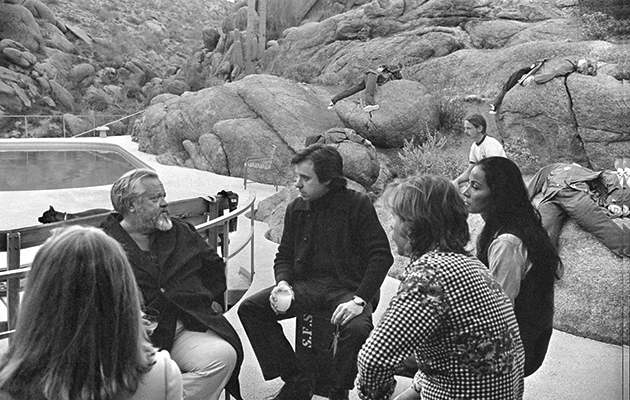
Fascinating and infuriating bullshit. Watch how the guys patronize the underage girl. Sexist and disturbing, but also indicative how they’ll treat people not like them: white, straight, male, connected, upper middle class, liberal/creative types. I felt uncomfortable watching it precisely because people like me don’t belong in that world. Look how smug the Peter Bagdanovich character is. The whole film is like that with John Houston prattling truisms endlessly. This was shot towards the post-Auteur period, but Welles and co. still believe in the centrality and self-importance of the film director. Even the film within the film seems like a throwback to Antonioni films of the 60s and the ruckus of studio and party life is pure Fellini. We get to see the Actress nude and cavorting impossibly in a western film set. She is supposed to be Pocahantas, dear god stab my eye now. The film doesn’t even have the balls to show us the Actor’s balls. It’s that kind of movie. If ever you wanna witness the train wreck that was/is white male privilege of the 70s, complete with homoerotic and homophobic undertones, this is your flick, film citizens.
Clever and funny horror flick from austerity Japan. Budget is small and so are the living quarters. It’s mainly set in an abandoned facility which may have been used for wartime atrocities too, folding Japanese war history with its industrialization and its current abandonment of such industries. The film isn’t even the main show, as the producer informs the director, but an amuse bouche for the film proper which will air right after. It’s not even cinema, but a pre-something, and yet it’s far more entertaining that many films these days. The English title is less effective than its Japanese original, which means “Don’t stop filming!” Interesting is the family formation that occurs in the movie, somewhat similar to Kore-eda’s assembled family of misfits in Shoplifters. I found this slightly regressive, to end with its reconstitution, but it’s only to be expected diegetically. Despite the laughs, there is a dark undercurrent with the way the director insists on letting the cameras roll: keep working until you’re dead, or, in this case, you’re the undead. Basically, that’s the ethos of Japan at the moment which the film captures too perfectly.
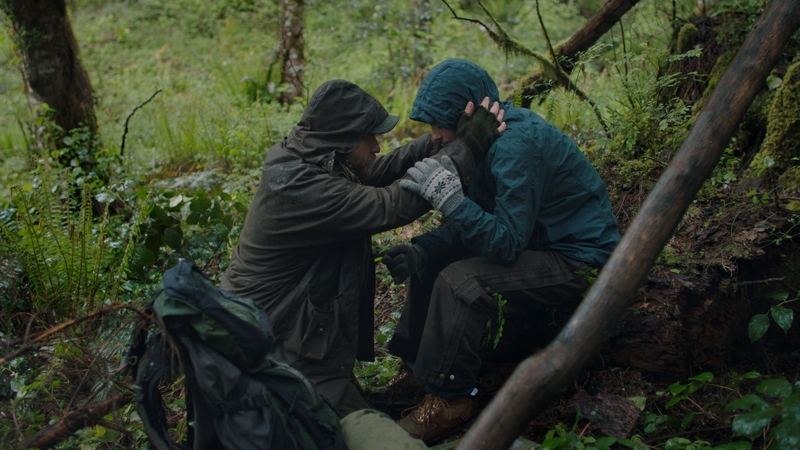
Nice film. Father and daughter have been living off grid but law catches up on them and they’re forced to integrate into society. He has PTSD but none of the scenery chewing. She is kind and caring, a rare representation for a teenage girl. Everyone they meet are concerned and helpful, but the PTSD gets in the way…
The film is also about community and wanting to belong. Yet, naggingly, kept wondering how the welcome mat would have played had it been a non-white father and daughter duo? The campsite they come upon is portrayed as a mini utopia, but is it really that much of an alternative community when the residents are all white and their entertainment features country music?
Being nice isn’t enough. It’s also mentioned that a resident or two has been in the army, meaning to say, a vet. Once more, we are shown the traumas of white males at the absence of the traumas of those who are not (First Reformed, The Rider, You Were Never Here). Even the final shot, which may be about liberation, as a figure steers away from the road and into the forest, is supposed to signify his release but, oddly, and this should no longer be ignored, where is the trauma of Native Americans who used to occupy the very space the man finds freedom?
The idea here is self-reliance of the individual and that of the community in the woods, an ideal made possible by centuries of land dispossession and enslavement of blacks. It’s a very tired kind of thinking and it’s not going away soon. The images of the community in the film seem to pander to the other community out there, the Trump voters, whether the film means to or not. There has been a tendency in the mainstream press to portray disaffected Trump voters as victims, and films like this one caters to that demographic. Where are the films that acknowledge the more progressive Americans? Take a look at what Boots Riley did with his film. Look at how different the dynamics of that community is, racially and politically.
One more thing. In the film, the dad figure is obsessed with the idea of not thinking like them, the rest of society, presumably, because of PTSD. BUT this kind of thinking is way too exclusionary in contemporary America because there is also the implication that it’s this multicultural America that he is turning away from. Not just him but that utopia of a community that he and her daughter comes across. Films like these don’t feed into Trumpmania, however, they also do nothing to challenge it, but normalize a kind of old fashioned America without historical reality of prejudice, exclusion, and violence.
To close, would like to point out where too is the trauma or PTSD of the other side of the war or conflict in which the dad figure was involved in?
What’s actually burning? Resentment at the rich? Yuen’s casting may also suggest the anger directed at Korean immigrants who made it good, actually so good, that they’ve been flaunting their successes back in Korea. He yawns at the boredom of his latest entertainment, women usually below his class and women who are insecure. And then at the heart of the film is the dance of the Great Hunger. Lee makes the yearning for more-than-this-life sentiment at the border of North and South Koreas, indicating that the reunification is also a yearning, hidden or not, among his countrymen. But he also has the rich man there which means it’s not just a question of reunification of geographical boundaries but also those who have been dispersed in the Korean diasporas. There’s an impossible spatial sequence in the film where the young writer is looking at images of militarism and protest while a few yards away, his rich counterpart is dining with his family. There’s a suggestion that the conversation about family is audible, which doesn’t seem possible. It’s yet another boundary within Korean society, the rich and the rest. What is the film doing? Or what is it burning to do? Two possibilities. One, miming. Second, actualizing. (Third could be dreaming.) Is she, the third protagonist, been miming all along indicated by the well story? Lee also places the onus on working class Koreans when the sister tells the writer that she can’t come home until the debts are paid. That’s cold. Then we get the shot of him finally writing. Is it yet another petition? Doubtful. It’s after this shot that the film turns truly scary and heartbreaking: the writer, bumbling, sensitive, thus far, turns to murder. The film seems to suggest that for the writer to achieve or surpass his Great Hunger he has to eliminate someone who may or may not have killed the young woman. The turn of events is not surprising especially in contemporary Korean cinema with its great revenge stories. This is his revenge moment, this is the another revenge movie, but what in fact is being avenged? Childhood trauma? National history? Economic disparity? Not having read the Murakami short story to which this is based, I can only assume it is about the usual Murakami anomie, but for Lee, the stakes are higher, it’s national AND global. It’s a very bleak portrait of our times.
Take a look at what the Coen Brothers did with Buster Scruggs. They’re reworking the western by providing unexpected characterizations and endings. But are they really going far enough when they are still using the same painfully tired stereotypes for Native Americans that continues to persist in the last hundred and dozen years of the genre and cinema? They really can’t see their limitations and in these time of increasing mainstream representations of minorities, they’ve been painfully tone deaf. This limitation is what keeps them in business, churning out film after film annually. Who else has that kind of privilege? Woody Allen? He’s gone. They’re the only auteurs in a major studio backlot that can do this yearly. The film is such a masterclass in acting, especially for character actors, and filmmaking, however if the content and tricks are same year after year what, seriously, is the point? It would even seem that they’re conscious of their status with the deaths in the film. The opening story talks about a legendary singer and gunslinger who’s time is finally up. A gold pan handler hits the mother load only to be scooped by another prospector. Is their time up too? Meanwhile Bujalski whose been mining the mumble core (sub?)genre appears to be more aware of the world around him by having a Black woman as a lead. Didn’t expect that from him where mumblecore films have been effectively a whites-only genre. Bujalski is careful at the characterizations of his other black figures too, like the depressed husband, which kinda harks back protagonist in Killer of Sheep. In fact, are they the updated couple from that film? Perhaps an objection could be that the film is set in a Hooters-like place with scantily-clad women and that some of the high jinks are corny. The film is also about class as one of them says, “there’s plenty of bullshit jobs out there”. For folks who’ve been there and who still are in low paid bullshit jobs, it’s nice to see such an acknowledgment on screen. It’s not the best of films, but one can sense that here’s a filmmaker who has tried to use his patented style to include those on the other side of the freeway. Or am I keeping the bar low since it’s coming from a white filmmaker?
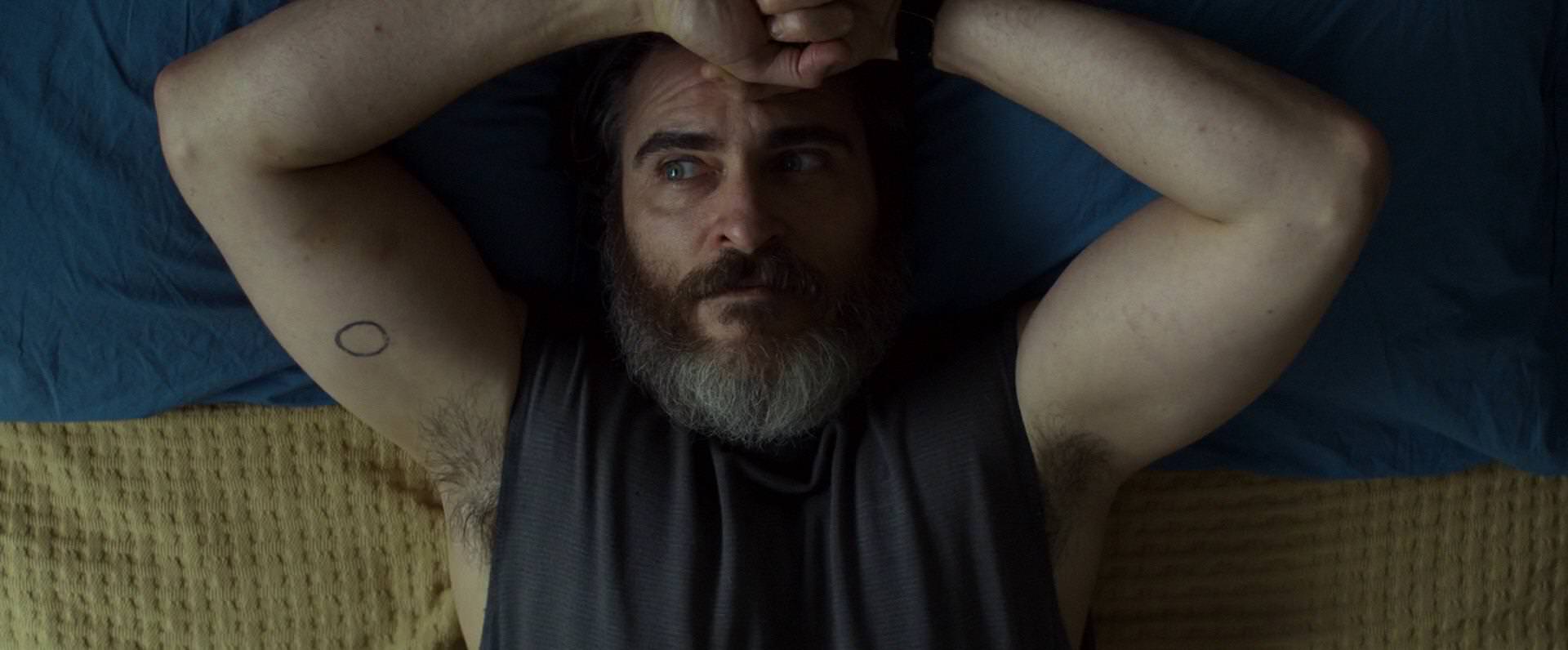
Lyrical retelling of Taxi Driver, to some extent. Ramsay’s NYC is also USA circa present day. The interiors are all wood paneling, a throwback to when things were more secure only to be told in flashbacks that things were never that great. Joaquin does the embodiment of the the crushed, sensitive, tough and violent straight American male, and here he’s heavily, heavily traumatized. In fact, the weight that he carries is not just personal, but national, with images indicating the ramifications of the Iraq War and illegal immigration. The movie works largely because of Ramsay’s use of sound design to create a nightmarish world of everyday violence. What I somewhat object to is the idea that it’s the white straight male who carries the burden of American civilization in the way Joe is impossibly traumatized by multiple traumas. It’s something I also detect in another recent film, The Rider. Why this obsession with white male trauma when, if you look at the news lately, it’s pretty obvious black men and women and other minorities who are the subjects of state sanctioned violence and who are the ones deeply traumatized. Where is that representation? Where is that representation within these films. In fact, Ramsay’s movie is no different from the usual Hollywood product where those in need of protection are young white girls. It’s their innocence that is at stake. How far is that from Birth of a Nation’s Lillian Gish’s fears of being raped and where the KKK riders are on their way to protect her from black men? It’s not much different. For decades, American society has been under economic assault for decades. For white society, their response has been to go after minorities and immigrants for their change in social status, because it’s the easy and less intellectually taxing to do so, what with conservatives fanning the flames, that it’s these other people who are making them poor or marginal. I feel that the movie, whether it likes it or not, is in line with this kind of thinking except that it’s artistically done. Like The Rider, we are made to sympathize with the broken straight white male while the rest of us, our pain complaints and fears, are ignored, unseen, disregarded. There’s even a shot of a young Asian woman in tears, but her pain is disconnected from anything in the movie. However, later, it’s revealed it’s his pain that motivates the image. White man’s burden trope as it’s finest.
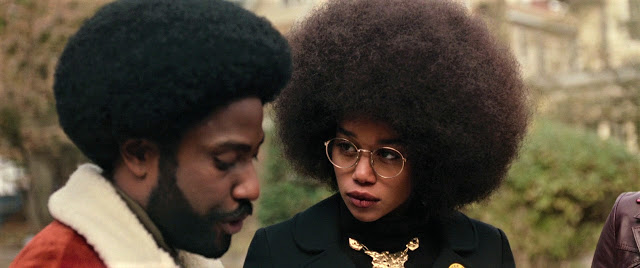
Interesting to see two films with black protagonists using the “white voice” released in the past year. For Lee, speaking with a white voice also means a black director making a Hollywood film about racism for the widest/whitest possible audience. The black protagonist, an undercover cop, calls it being a professional. Now I don’t know which aspects of the book has been fictionalized and sensationalized, but I felt an uneasy at the artistic decision to crosscut between the klan meeting and black activists’ gathering. It has this weird effect of equating both events, even though it’s presented as how these two groups are very different. It’s so weird to see a full-on klan initiation in a film about racism where something like this in another movie could be problematic. On the other hand, we get to hear a gut wrenching account of lynching and how it was such violence was normalized back then that children attended these racist spectacles. Lee also shows us images from actual lynchings, something that probably has been a Hollywood taboo. I kept wondering if this crosscutting could have been done differently, or is this an aesthetic echo to Griffith’s innovative use of cross cutting in that fucking odious film Birth of a Nation that the film shows short snippets of. We also get to see an obviously tacked on segment of a racist and sexist police officer getting his due. The segment works as a way of reconciling one’s uneasiness with the way the film shows how the police can be a force of good for black people. Huh!?! Is this what it takes to get a film about race, racism, and rising white nationalism, produced in Hollywood? Is this what it means to be a professional in the system? Then Lee gives us a powerful ending from recent events of protests involving American Nazis and counter-protestors, splicing it with together with fury and finesse. It’s that film I wanted to see. It seems like that’s the film he wanted to make. It’s that film that we need.
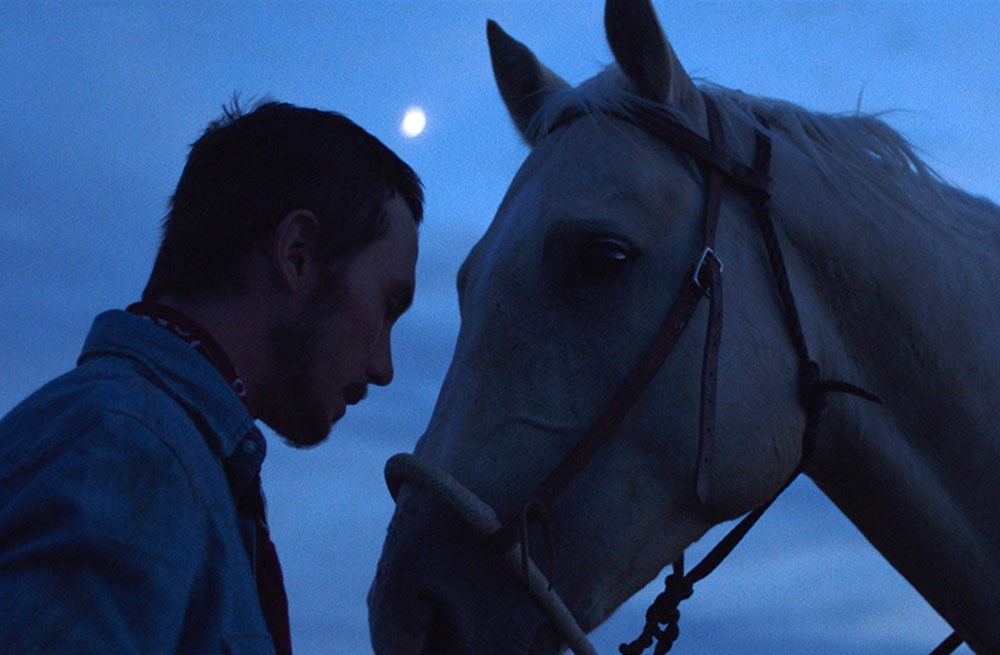
Nice small film that’s on the conventional side, Zhao and co. offer us a milder, more sensitive western. What’s so refreshing is how non-bombastic the film is with regards to Americana (though it’s still there); toxic masculinity; “race”; etc., while addressing these issues in its own way. (I kept thinking how Clint Eastwood would have filmed this?) The best feature of the film is the non-antagonistic relationship the protagonist has with his sister. American indie films rely on the heavily cliched family psychodramas that Zhao tones down to almost nil. There are the confrontations with the father figure, but they’re not so explosive as to give the actors to overact. It’s a tender portrait of a family and community that the film presents. Instead of the usual female love figure, we get a caring friendship. It’s so startling to see a western peopled by folks with mental and physical disabilities, with indigenous looking people, and a central hero who is kind and considerate. Note the small gestures like when the young girl shakes hands with him. Things like that. On the other hand, as a western, a truly problematic genre, the film still traffics in the romance of the landscape. There’s no discussion of settler colonialism and its effects on Native Americans. Every time a pretty landscape and lonely cowboy is featured, it done so to convey his heroism, instead of the pain and loss that results in settler colonialism. Can we move past this imagery? From this romance? Race is also unspoken, though it’s there as some characters are hinted as part Native, but so what? The movie would not have been made with an actor who doesn’t look phenotypically too Native American, and that’s the kind of western is what I’m looking for.
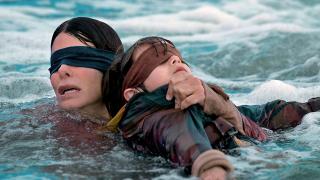
Instead of asking what the movie is about, why not venture to ask why does this movie exist? This is a story movie. The characters don’t matter as much. Why this rather nifty story, though not quite original since we’ve got A Quiet Place this year, except here they need to cover their eyes. Well, it’s being willfully blind and ignorant about the things in our world, things like racism; environmental catastrophe; rising fascism; etc. Actually, it has the same weird post-racial sensibility in Annihilation, which is really about fears of assimilation from alien, non-white bodies. Note also the choice of the house where these Crash survivors live. It’s set in L.A. with people from all walks of life crashing into a posh and expansive 626 arts and crafts house. So from the get-go we are to believe in the existence of a post-racial world EXCEPT it still follows the logic of our current racist world and Hollywood template of what constitutes race and diversity. How so? Note the order and choice of the people who get killed AND those who don’t get killed. People have been pointing this out about horror movies that by now, surely Hollywood should have gotten the message. First victim is the Asian guy who happens to be gay. WAIT, the Asian man, already a near-extinct species in Hollywood representation, has to be gay!?! Not that anything is wrong with being gay BUT this is clearly in line with Asian men as being emasculated. (He’s a bottom, you could almost hear. And the unseen husband, he’s white, you could hear that too.) Next, the conspiracy theory black dude gets killed. The two young white pretty things bone each other and then poof, they’re gone. I think she is supposed to be a Latina, light-skinned and phenotypically white enough. She and the white dude get the best kind of representation because we don’t see or hear them being killed, unlike the central couple, an idealized post-racial paring, where the black partner dies. It’s almost as if the movie can’t stand the fact that this interracial coupling exists at all. (Also problematic is the figure of not the heavy set white woman. Why does she have to be a bit crazy?) And you know those WHITE kids won’t die–that’s Hollywood taboo. So we end up in yet another post racial utopia which looks like images from those Mormon magazines where people of all stripes get along laughing, smiling, which doesn’t make sense because the world as they used to know it is dead and the monsters are still lurking outside. The plaque says it’s a school for the blind, but more like school for fools.
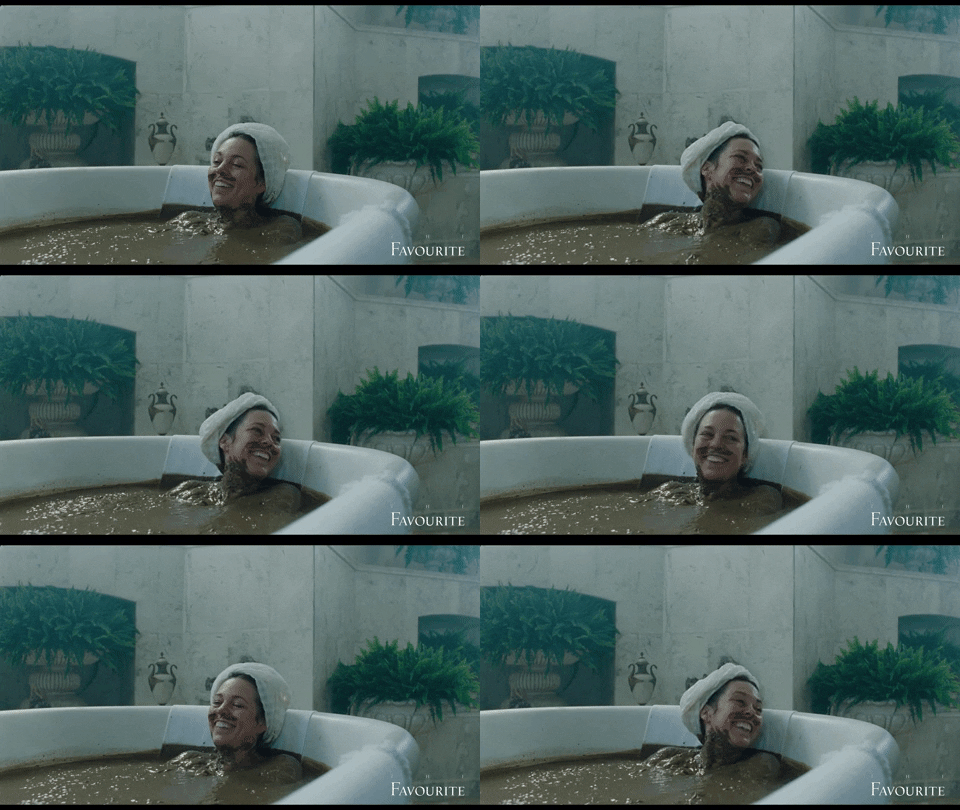
An ahistorical historical film. Imagine the film’s scenario in the present, like the way the dancing sequence indicates, which by the way has been done to startling effect at least 15 years ago by Sofia Coppola and a teenybopper Heath Ledger movie, there’s no way the film’s representation of women can be deemed kosher. The message is that women with power have lesbian tendencies and their idea of intimacy is dictated by cruelty and manipulation. They will cut their fellow females. It’s a nice male fantasy. Who is this movie for? I’ve always asked this question with regards to Yorgos’ films. Previously, I surmised that they’re for the hipster crowd and that it’s this hipster irony that makes his films travel from Greece to Greenpoint, Brooklyn. I think they are for people who think cruelty and nastiness as edgy. I also think they’re for the culturally feeble minded who mistake high concept for profundity. (Yorgos makes films in the same camp as Haneke. More cruel=more art.) The frame of the story is sturdy enough, with its intriguing and sellable concept, but his characters are one-dimensional, really. There’s not enough motivation for the Emma Stone character to get dirtier once she has climbed the social ladder. Earlier, she is associated with books, a kind of thoughtfulness, but this idea is dropped, because it turns out that’s not the point of the character. The ending is artsy fartsy nonsense because that’s not really an ending, not even a decent Persona evocation, but a cop out, a mysterious enough series of images, of insincerity, multiplied.
 Orpheus in Hell: Unlicensed Film Reviews