Why is yellow middle of rainbow? (d. Kidlat Tahimik)
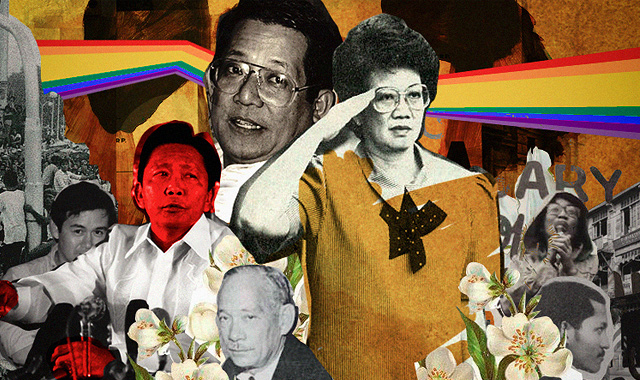
This is one of the stronger works by Tahimik and the key to understanding his latest film (Balikbayan Box) except that the latter is still a mess unlike this one which is essentially a video diary of the 80s decade. It’s joyous, witty, observant, and, as far as I’m concerned, riddled with major problematic ideas. It’s a treasure trove of images, especially when the country turned yellow, the party color of Cory Aquino whose husband’s assassination began the beginning of the decline of the Marcoses and where she would eventually run for President. In fact, watching demonstrators in support for Aquino and against Marcos made me incredulous at the current state of the country where another tyrant (Duterte) is in the making who is also ushering the return of the Marcoses back into the limelight. All that fervor and hope for change gone from the affective record of the people’s hearts. The Aquino presidency was in itself a disaster, something that is recounted here as a series of attempted coups instead of continuing corruption that was no different from the Marcos era. There’s also a segment on a road trip that ends up in Death Valley which playfully plays off American Western films and the “indios” and “tontos” of the world. On the other hand, one of Tahimik’s problems is his conception of the indigenous. For him, anyone can be indigenous, including an expat from Estonia. This explains my discomfort of seeing his sons, one of them white, tall, and blonde, wearing an indigenous Filipino garment performing a traditional dance representing the Philippines for foreigners. Gross. For Tahimik being indigenous is cultural and a turning away from European and American cultures all the while speaking English almost entirely in the film and using forms, film essay or the docu-fiction, which doesn’t seem suited for Filipino audiences but to the film festival West. (I’m not saying Filipinos aren’t capable of understanding such forms, but it’s telling, for instance, how Tahimik puts together his films, at nearly 3 hour lengths, where can he show such works in the country? Sure in Manila, it’s not a problem, but Manila isn’t the Philippines. Who has the facilities and time for this? Why is the journey motif in the work all in the West and the one within the country is fairly limited? Tahimik keeps using the phrase “strong contradiction” and his work can be summed up with that phrase all too perfectly.) Another major issue is how he equates the militant communists living in the hinterlands with the Philippine army. He faux-naively wants peace and he doesn’t trouble to explain to his audiences why the rebel communists exist and continue to do so up to this day. Yes, they have committed violent acts, but they’re nothing compared to the army’s. And why are they not quelled? It’s because of land and the gross unevenness of wealth in the country, which is a point that never appears in his films despite his MBA from Wharton. This is why Tahimik’s idea of indigeneity is troublesome, because it’s all cultural to him and the land or material aspect isn’t there. He moans and moans constantly of American pop culture’s intrusion into Filipino society, a valid enough argument, but he keeps using the same references and, if you listen carefully, the same cliched wordings as if there aren’t other non-American cultures one can draw from. So this is why I find him disingenuous and dis-indigenous. On the other hand, these are vital documents, the films of Tahimik as they are unlike any other and it is for that that I’m grateful and these films should be seen as works by someone who struggled with what he had, materially and conceptually, at that time while reckoning with his immediate history, strong contradictions and all.
#2019 #57
 Orpheus in Hell: Unlicensed Film Reviews