Onna no Issho / A Woman’s Life (d. Yasuzo Masamura)
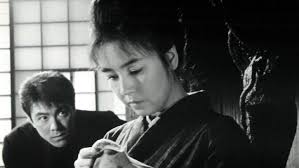
Incredible. It’s probably a masterpiece. I watched it without subtitles so I’m holding off making a definitive declaration. It’s about this poor woman, beaten like a dog right from the first scene by her aunt, who goes on to mosey into a grand estate and ends up, first, as a maid, confidante next, a wife to one of the estate’s sons later, and, finally, a Mildred Pierce-like, head of the family’s business as the (spoiled) kids can’t be bothered by the vulgarity of making a living. Part of unappealing nature of the business is because they have been cashing in from military contracts since the time of Sino-Russo wars. The film follows the family as Japan becomes more right wing and then finally enter into WWII. Our female protagonist is given a choice between love and war, and grateful as she is to the son who helps her become part of the household, she chooses the latter, which is the patroness’ preference played by the iconic mother figure in Tokyo Story but SO DELICIOUSLY WICKED here. And from here on out, the movie stages incident upon incident where the consequences of her choice keeps splitting in two directions or where the viewers are aware that there are two things going on internally that the heroine can not explain as she interacts with various family members who do not attempt to understand her at all and who do not understand that their middle class lifestyle is really indebted to her sacrifices. Masumura isn’t done yet. As much as we want to sympathize with her, he shows that she is deeply sympathetic to right-wing movements for purely financial reasons. The wealth isn’t for her but for everyone else, including her daughter who slowly begins to resent her, mimicking a long-standing tradition of family members disrespecting her.The heroine’s pursuit for war profit and politics trouble our potential feelings of sympathy with the character. The mis-en-scene is wildly unconventional with chandeliers and telephones looming in the foreground. What is going on, Masumura-san? I read these objects as material manifestations of immovable things like tradition, culture, family, nationalism, etc. that prevent and obstruct the characters from breaking out of their mindsets. The film is clearly anti-war that I couldn’t figure out how the studio signed off on such a script. One character flatly says, “Well Japan is in China just to make money out of it”. (I wonder if this is the reason the film isn’t more well-known or why it doesn’t seem to have Japanese champions because of its hardline stances.) This film was made in 1962. The heroine is played by Machiko Kyo, a huge star, so she too must have known what was up. The most sympathetic character is a war resister and his fate is clear (killed) despite their reappearance later in what amounts as a possible happy ending (as a ghost), and, as I walked home and thought more about the final sequence and its implications, I realized that it is a terribly tragic one: even in death some keep on suffering for the sake of others, which the movie means Family, Nation, and Culture. Um, fuck that shit.
#2019 #76





 Orpheus in Hell: Unlicensed Film Reviews